Hidden Fees and Fine Print: How to Compare Yacht Ownership Contracts

In Short:
Many U.S. buyers are surprised to learn that charter yacht ownership may offer potential tax advantages when a vessel is structured and operated as a legitimate business asset. Depending on individual circumstances, qualifying yachts may be eligible for depreciation benefits while generating charter income through a professionally managed ownership program. However, tax outcomes vary significantly, which is why every buyer should consult a qualified tax professional before making decisions based on potential deductions.
For years, most yacht ownership conversations focused on lifestyle, destinations, owner use, and charter income opportunities.
Today, buyers are asking a different set of questions:
These questions are especially common among U.S. buyers evaluating charter ownership as part of a broader financial strategy.
If you’ve already explored the financial side of ownership, including our article on whether charter yacht ownership is a smart financial move or prepaid charters, and our breakdown of down payments, financing, and the true cost structure of yacht ownership, then understanding potential tax treatment is the next logical step in the decision-making process.
The short answer is: Possibly, but not automatically.
A common misconception is that every yacht purchase creates tax deductions. In some circumstances, a yacht placed into charter service may qualify for tax treatment that differs significantly from personal recreational ownership.
For certain buyers, placing a yacht into a legitimate charter business operation may create opportunities that are not typically available with purely recreational ownership. However, specific requirements must be met, and every situation is different.
That’s why tax professionals generally recommend evaluating the ownership structure before purchasing the yacht.
One of the most-discussed topics among prospective owners is bonus depreciation. In plain English, depreciation allows a business asset to be written off over time as it is used in business operations.
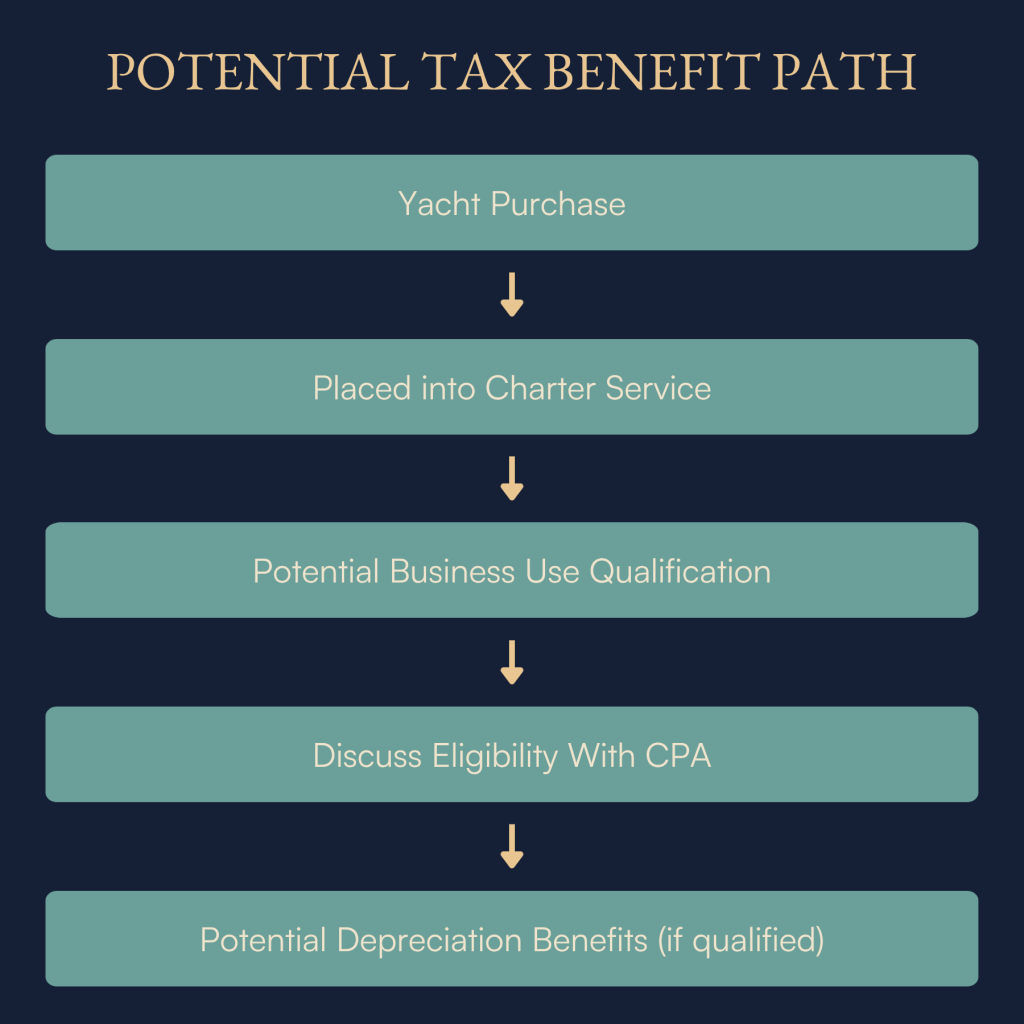
Current provisions discussed in The Moorings 2026 Yacht Buyer’s Tax Brief may allow qualifying business yachts to receive substantial first-year depreciation benefits when properly structured and operated.
That does not mean every yacht owner qualifies. It also does not mean every owner receives the same outcome.
Tax results depend on individual circumstances, business structure, income levels, documentation, and other factors that should be reviewed by a qualified advisor.
Another question buyers frequently ask is: “What happens if I don’t use the full depreciation benefit in year one?”
According to The Moorings’ Tax Brief, remaining value may continue to be depreciated over time under MACRS rules, potentially creating future tax benefits depending on an owner’s situation.
Again, this is where professional tax guidance becomes critical because individual circumstances vary widely.
While every situation is unique, advisors typically focus on several major areas when evaluating whether a yacht may qualify for business-related tax treatment.
The vessel generally needs to be operated primarily for qualifying business activities rather than purely personal recreation.
Owners may need to demonstrate involvement consistent with applicable participation requirements.
Accurate records matter.
Examples may include:
Professional recordkeeping is often an important part of maintaining compliance.
Many buyers explore ownership through business entities such as LLCs or other structures as part of an overall planning strategy. The appropriate structure should be determined with professional guidance.

Many prospective owners first learn about yacht tax strategies while researching charter ownership programs.
A professionally managed ownership model can help transform a yacht from a purely recreational asset into part of an operating charter business.
For that reason, many buyers researching depreciation or yacht-business strategies eventually investigate how guaranteed income yacht ownership works and what to watch for before choosing a program.
Through The Moorings Guaranteed Income Program, owners receive predictable income while professional teams handle charter operations, maintenance, insurance, dockage, and yacht management throughout the program term. For many buyers, this structured ownership model is what first introduces the possibility of treating a yacht as part of a legitimate charter business rather than as a purely recreational asset.
However, participation in a charter program alone does not determine tax outcomes. Qualification depends on an owner’s individual circumstances and should always be reviewed independently by qualified professionals.
False.
Qualification depends on business use, documentation, ownership structure, and numerous additional considerations.
Not necessarily.
Successful ownership decisions usually balance lifestyle goals, charter income, travel plans, financial considerations, and potential tax treatment.
Be cautious of anyone making guarantees.
Tax benefits vary significantly from owner to owner.
Before making a purchase decision, consider asking:
These conversations are often most productive before the yacht is purchased and placed into service.
This article is intended to provide educational information, not legal or tax advice.
Because tax laws, ownership structures, and individual financial situations vary, The Moorings encourages prospective buyers to consult qualified tax professionals before making ownership decisions.
For buyers seeking professional guidance, The Moorings 2026 Tax Brief includes contact information for USCG Capt. Patrick Wehrly, EA, who is admitted to practice before the IRS and specializes in maritime tax matters.
For some U.S. buyers, charter yacht ownership may offer more than access to world-class sailing destinations.
When structured appropriately, a yacht used in a legitimate business capacity may create potential tax advantages alongside charter income and owner-use opportunities. However, qualification requirements are complex, and no two ownership situations are exactly alike.
Many buyers exploring tax considerations are not necessarily trying to maximize investment returns; they are looking for a more structured, predictable approach to yacht ownership that combines lifestyle access with professionally managed charter operations.
The best approach is to understand the opportunities, ask informed questions, and work with qualified professionals to determine what may apply to your specific circumstances.
If you’re still evaluating whether ownership makes financial sense for your situation, we recommend reading whether charter yacht ownership is a smart financial move or simply prepaid charters, our real-world break-even analysis of yacht ownership versus chartering over five years, and our guide to down payments, financing, and the true cost structure of yacht ownership before making a purchase decision.
Can a yacht qualify as a business asset?
Potentially, yes. In certain situations, a yacht that is operated as part of a legitimate charter business may be treated differently than a purely recreational vessel. Qualification depends on factors such as business use, ownership structure, documentation, and individual tax circumstances.
Do all yacht owners qualify for tax benefits?
No. Tax benefits are not automatic and do not apply to every ownership situation. Eligibility depends on how the yacht is used, how it is structured, and whether applicable requirements are met. Always consult a qualified tax professional before making purchase decisions.
Can I still use the yacht personally if it is part of a charter program?
Personal use is often possible, but the amount of personal use and how it is documented can be important factors when evaluating tax treatment. Your CPA or maritime tax advisor can help determine what may be appropriate for your situation.
What records should yacht owners keep for tax purposes?
Good recordkeeping is essential. Depending on your situation, this may include charter activity records, receipts, contracts, business-use documentation, and other supporting materials. A qualified tax advisor can provide guidance on what documentation should be maintained.
Does a Guaranteed Income Program automatically create tax benefits?
No. Participation in a charter ownership program does not guarantee any specific tax outcome. Tax treatment depends on your individual circumstances, business structure, level of participation, and compliance with applicable requirements.
What is bonus depreciation for a yacht?
Bonus depreciation is a tax provision that may allow qualifying business assets to be depreciated more quickly than under traditional schedules. Certain charter yachts may qualify when structured and operated appropriately, but eligibility depends on individual circumstances and should be reviewed with a qualified tax professional.
Should I buy a yacht primarily for the tax benefits?
Most experienced owners would say no. Tax considerations can be an important part of the overall ownership picture, but they are only one factor among many. Lifestyle goals, destinations, owner use, income potential, and long-term plans should all be part of the decision-making process.
Who should I talk to before purchasing a yacht for charter ownership?
Before making a purchase, it’s wise to speak with both a yacht ownership specialist and a qualified tax professional who understands charter yacht ownership. They can help you evaluate whether the ownership structure aligns with your financial, tax, and lifestyle goals.
The information in this article is intended for educational purposes only and does not constitute legal or tax advice. Every ownership scenario is different, and potential tax benefits depend on individual circumstances.
Before making a purchase decision, The Moorings encourages prospective owners to consult with a qualified maritime tax professional and discuss how charter yacht ownership may fit into their broader financial and lifestyle goals.
Ready to explore ownership?
Contact The Moorings Yacht Ownership team to learn more about available yachts, ownership programs, and the resources available to help you evaluate your options.

Katie is the Yacht Sales Marketing Manager for The Moorings Yacht Ownership. She loves to create content that helps buyers understand how ownership works and what to expect along the way.